
Grade 1, 2 and 3 describe one thing: how much fat is scattering the ultrasound beam as it passes through your liver. None of the three grades measures scarring, and scarring is what decides outcome. All-cause mortality runs 0.32 per 100 person-years at fibrosis stages 0–2 against 1.76 per 100 person-years at cirrhosis (AASLD Practice Guidance, 2023).
This article is for people in Chennai who have just read one line at the bottom of an abdominal ultrasound report — grade 1 fatty liver, or grade 2, or fatty infiltration of the liver, usually before any doctor has explained it. It covers what the grade describes, how reliable that grade is, which tests come next, and what the published evidence says actually changes the liver. It is not about hepatitis testing pathways, and it is not a substitute for reading the whole report with the doctor who ordered it.
One boundary first, because the anxiety this finding causes sends people to the wrong place. A fatty liver reported on a routine scan is not an emergency and does not need same-day review. But yellowing of the eyes or skin, swelling of the abdomen, vomiting blood, black tarry stools, or new confusion or drowsiness are hospital problems, not outpatient ones. AJSMC in Egmore, Chennai is an outpatient and day-care centre with no emergency department, no inpatient beds and no intensive care, and it is closed outside Monday to Saturday, 10am to 9pm. For any of those signs, at any hour, go to a hospital with a 24-hour emergency department or call 108.
What does grade 1, 2 or 3 fatty liver actually mean?
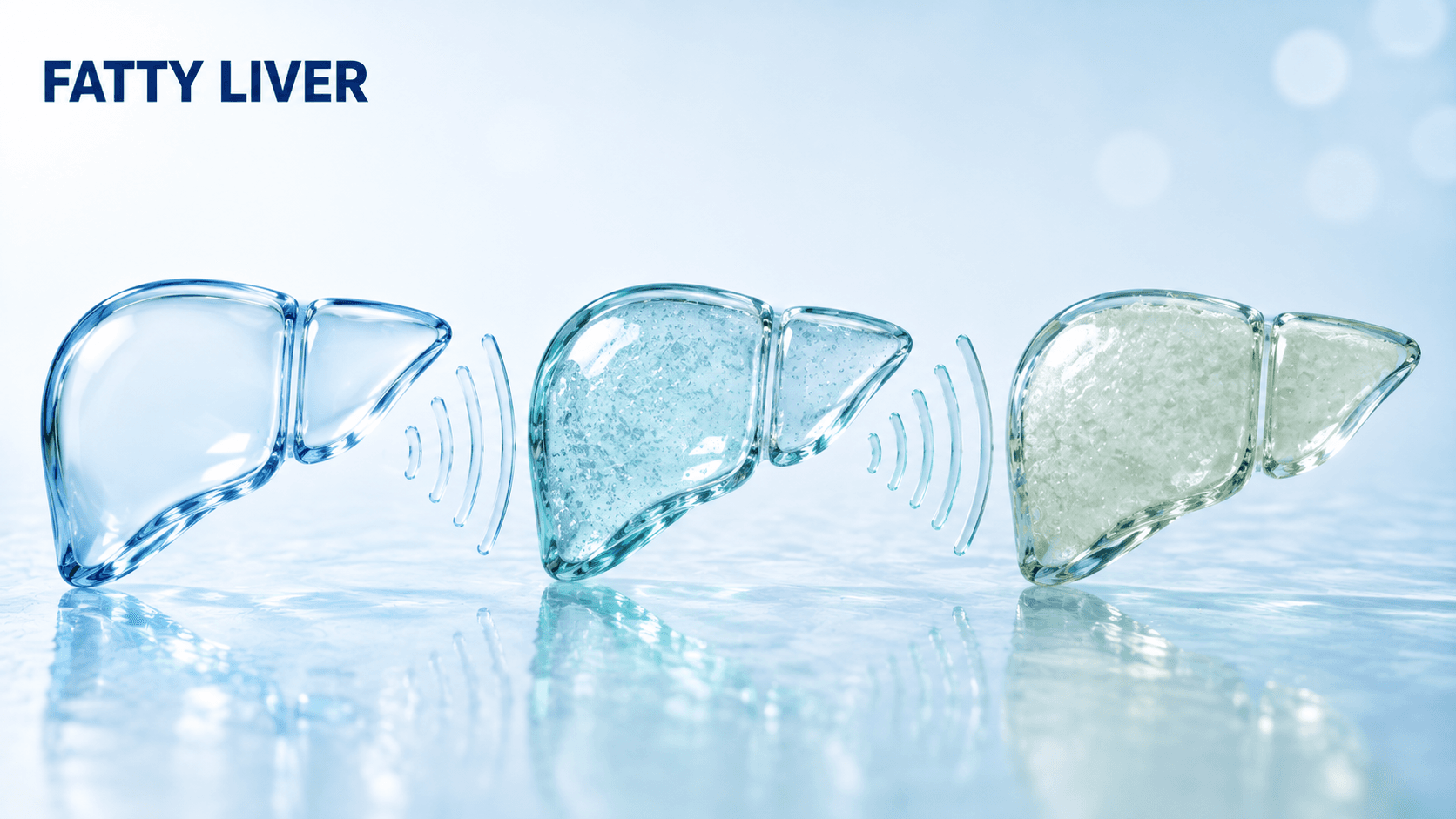
It means the radiologist judged three things by eye: whether the liver looks brighter than the kidney beside it, whether the walls of the portal veins and the diaphragm are still visible through it, and how far the ultrasound beam still penetrates (Korean Journal of Radiology, 2022). The grade is a description of the picture, not a stage of disease.
| Grade | What the radiologist saw | What it does not tell you |
|---|---|---|
| Grade 1, mild | Liver brighter than the kidney; diaphragm and portal vein walls still clearly seen | Nothing about scarring, inflammation or prognosis |
| Grade 2, moderate | Liver brighter still; the diaphragm and portal vein walls becoming blurred | Nothing about scarring, inflammation or prognosis |
| Grade 3, severe | Liver markedly and unevenly bright; the beam no longer penetrates; diaphragm obscured | Nothing about scarring, inflammation or prognosis |
Source: Korean Journal of Radiology, 2022.
Two consequences follow, and they are the reason this page exists. A grade 1 liver can carry advanced scarring, and a grade 3 liver can carry none. So a patient in Chennai who has been told "only grade 1, nothing to worry about" and a patient told "grade 3, this is serious" have both been given information the scan cannot supply.
How reliable is the grade itself?
Less reliable than the confident single line on the report suggests. Agreement between two radiologists grading the same B-mode ultrasound is moderate at best, and the same reader grading the same liver twice does not always return the same answer.
| Measure | Value | What it means in practice |
|---|---|---|
| Agreement between two observers | kappa 0.43 | Two radiologists frequently disagree on the grade |
| Agreement of one observer with themselves | kappa 0.54 | The same reader can grade the same liver differently |
| Sensitivity for mild steatosis (over 0–5% fat) | 73.3% | Roughly one in four mild cases is missed |
| Accuracy in people with obesity | Reduced | Reduced in exactly the group most likely to be scanned |
| Telling fat from scarring | Not possible on B-mode | Steatosis can have echo characteristics similar to advanced fibrosis (AASLD, 2023) |
Source: Korean Journal of Radiology, 2022; AASLD Practice Guidance, Hepatology, 2023.
The American guidance goes further than most patients expect. AASLD's Guidance Statement 17 (2023) says standard ultrasound is not recommended as a tool to identify fatty liver, because of low sensitivity across the whole spectrum of the disease. The corollary matters just as much for anyone in Chennai whose scan came back clean: AASLD states that the absence of detectable steatosis on ultrasound does not exclude steatohepatitis or fibrosis.
Is fatty liver serious, or is this an incidental finding?
Both, depending on a number the scan did not measure. Fatty liver is extremely common in India, a systematic review and meta-analysis put pooled prevalence at 38.6% of Indian adults and 35.4% of Indian children (Journal of Clinical and Experimental Hepatology, 2022). It is also not confined to people who look overweight. A separate global meta-analysis of 53 studies, covering 65,029 people with the condition, found lean fatty liver in 11.2% of the general population and in 25.3% of everyone with the condition (Hepatology Communications, 2020), a worldwide figure rather than an Indian one. The Indian meta-analysis itself reports a non-obese prevalence only for children, at 12.4%.
What separates the incidental finding from the serious one is fibrosis stage. AASLD (2023) states that fibrosis stage is the best predictor of long-term outcome, and that bridging fibrosis and cirrhosis carry an exponentially greater risk of liver-related illness and death than earlier stages.
| Fibrosis stage | All-cause mortality |
|---|---|
| Stages 0–2 | 0.32 per 100 person-years |
| Bridging fibrosis (F3) | 0.89 per 100 person-years |
| Cirrhosis (F4) | 1.76 per 100 person-years |
Prospective cohort of 1,773 patients, cited in AASLD Practice Guidance, Hepatology, 2023. Ultrasound grade 1, 2 or 3 does not appear anywhere in this table, because ultrasound does not measure fibrosis.
That is the turn of the whole subject. The grade tells you the liver has fat in it. The question that decides what happens over the next twenty years is how much scarring has developed, and answering it takes a blood-based score, sometimes elastography, and a clinician who has looked at the rest of the picture.
Why is it now called MASLD instead of fatty liver disease?
Because the definition changed, not only the label. A multisociety Delphi consensus of 236 panellists from 56 countries renamed non-alcoholic fatty liver disease (NAFLD) as metabolic dysfunction-associated steatotic liver disease, or MASLD, and NASH as MASH (Journal of Hepatology, 2023). Seventy-four per cent supported a change; "non-alcoholic" was judged stigmatising by 61% of respondents and "fatty" by 66%.
The substantive change is the logic of the diagnosis. NAFLD was a diagnosis of exclusion — fat in the liver of somebody who does not drink much, with other causes ruled out. MASLD is a diagnosis of inclusion: fat in the liver plus at least one cardiometabolic feature, which is why the blood tests that follow the scan are aimed at the metabolism as much as at the liver. Those features are raised body weight or waist measurement, raised blood sugar or established diabetes, raised blood pressure, raised triglycerides, and low HDL cholesterol, with thresholds set lower for Asian populations than for Western ones. Ask the consultant which cut-offs apply to you rather than reading a figure off a website; several are quoted inconsistently in secondary sources.
A second new category, MetALD, covers people who have the metabolic features and also drink meaningfully. It exists because the two do not simply add up, as the next section explains.
Which tests come next after the scan?
Blood, and mostly not liver blood. This is the initial work-up AASLD (2023) sets out after a fatty liver is found.
| Test | What it tells you | What it does not tell you |
|---|---|---|
| Hepatic panel — ALT, AST, alkaline phosphatase, bilirubin | Whether there is current liver injury; the values feed the FIB-4 score | Normal enzymes do not exclude steatohepatitis or advanced fibrosis (AASLD, 2023) |
| Complete blood count with platelets | The platelet count feeds FIB-4; a low count can hint at portal hypertension | Not a fibrosis test on its own |
| Fasting plasma glucose and HbA1c | Whether a cardiometabolic criterion is met; diabetes drives progression | Nothing about the liver directly |
| Fasting lipid profile | Triglycerides and HDL are two of the defining criteria | Nothing about fibrosis |
| Creatinine with urine albumin-to-creatinine ratio | Kidney risk travels with this diagnosis | Nothing about the liver |
| Hepatitis C serology, if not previously screened | Excludes a separate, treatable cause | — |
| If enzymes are raised: autoimmune serology, transferrin saturation, ceruloplasmin, alpha-1 antitrypsin | Excludes autoimmune hepatitis, iron overload, Wilson disease and alpha-1 antitrypsin deficiency | — |
Source: AASLD Practice Guidance, Hepatology, 2023, Table 1. The same guidance asks for the history alongside the bloods: weight history, current and recent medicines, family history of diabetes, fatty liver or cirrhosis, screening for obstructive sleep apnoea, and alcohol intake by amount, pattern and duration.
AJSMC has an in-house laboratory in Egmore, Chennai handling blood and urine samples, and its outpatient hours are Monday to Saturday, 10am to 9pm. Before travelling for any test named on this page, call 044 2532 2021 and ask which of them are run in the building and which are not, so a sample is not given in the wrong place.
Why are sugar and cholesterol tested for a liver problem?
Because for most people the liver is the least dangerous part of the diagnosis. AASLD (2023) records that the commonest causes of death in this population are cardiovascular disease and cancers outside the liver, ahead of liver disease itself. The panel is risk-stratifying the person, not only the organ, and the metabolic findings are also what put the M into MASLD.
The practical version for a patient in Chennai: a grade 1 report that arrives alongside a raised fasting sugar and a raised triglyceride level is a different clinical problem from the same grade 1 report with normal metabolic bloods, even though the scan line reads identically.
What is FIB-4, and when is elastography needed instead of another ultrasound?
FIB-4 is a score calculated from four things already on the reports — age, AST, ALT and platelet count, so it usually needs no extra blood at all. It is a rule-out tool: it is best at identifying people whose probability of advanced fibrosis is low, and AASLD recommends it as the first-line assessment outside specialist practice for exactly that reason. Elastography enters when FIB-4 cannot settle the question.
| Test | Advanced fibrosis unlikely | Advanced fibrosis likely | Caveats the doctor applies |
|---|---|---|---|
| FIB-4 (age, AST, ALT, platelets) | Below 1.3 | Above 2.67 | Above age 65 a cut-off of above 2.0 is used; low accuracy under 35; not valid during acute illness |
| NAFLD Fibrosis Score | Below −1.44 | 0.672 or above | Not accurate under 35, or in obesity and type 2 diabetes |
| ELF blood panel | Below 7.7 | 9.8 or above | Reference laboratory test; 11.3 or above predicts liver-related events |
| Vibration-controlled transient elastography (FibroScan) | Below 8 kPa | 12 kPa or above | 20 kPa or above suggests cirrhosis |
| Magnetic resonance elastography | Below 2.55 kPa | 3.63 kPa or above | 5 kPa or above suggests cirrhosis |
| CAP, measured with FibroScan | — | 288 dB/m or above indicates steatosis | Measures fat, not fibrosis, and quantifies it only roughly |
Source: AASLD Practice Guidance, Hepatology, 2023 — Table 5 for the thresholds, and the same guidance for the above-2.0 cut-off over age 65. The 2024 EASL–EASD–EASO guidance runs a comparable stepwise pathway, FIB-4 first and elastography if FIB-4 is 1.3 or higher. These thresholds are what a clinician uses to choose the next step; they are not a self-assessment tool, and a number read off your own report without the rest of the picture will mislead more often than it helps.
How soon should the scan be repeated?
Repeating the ultrasound is usually not what is being followed up. What AASLD sets intervals for is the FIB-4 score: reassessment every 2–3 years where FIB-4 is below 1.3 with no prediabetes or diabetes and one or two metabolic risk factors, and every 1–2 years where there is prediabetes or diabetes or two or more risk factors. Those are blood-test intervals, not scan intervals, and no source in this pathway recommends serial ultrasound to monitor a known fatty liver. Whether and when to repeat any imaging is a decision for the consultant who has your bloods in front of them.
Can fatty liver improve, or is it permanent?
It can improve, and the evidence is unusually specific about how much change is needed for how much benefit. AASLD (2023) states that weight loss of 3–5% improves steatosis, but that greater weight loss, above 10%, is generally required to improve steatohepatitis and fibrosis. The underlying study followed 293 patients with biopsy-proven steatohepatitis through 52 weeks of lifestyle modification, with 261 paired biopsies.
| Weight reduction achieved | What the repeat biopsy showed |
|---|---|
| 3–5% | Improvement in steatosis, the fat itself (AASLD, 2023) |
| 5% or more | Steatohepatitis resolved in 58%; a 2-point fall in activity score in 82% |
| 10% or more | Activity score fell in 100%; steatohepatitis resolved in 90%; fibrosis regressed in 45% |
| Whole group | Resolution in 25%; activity score fell in 47%; fibrosis regressed in 19% |
Vilar-Gomez et al., Gastroenterology, 2015. Read these figures for what they are: outcomes in people with biopsy-confirmed steatohepatitis inside a supervised 52-week programme, not a promise to someone holding a grade 2 report with no fibrosis assessment. The pattern that transfers is the dose-response, the fat responds to modest change, the scarring only to large and sustained change.
Two further points from the same guidance. Exercise produces benefit in the liver independently of weight loss, which matters for anyone whose weight will not move. And weight reduction is expressed in the sources as a percentage of body weight for a reason: a target in kilograms, set by a website rather than by the person's own doctor, is not what any of this evidence tested.
What does not work is worth saying plainly, because it is the entire commercial market around this diagnosis. No tablet, tonic, syrup, supplement or liver-detox product treats the fatty liver found on a routine scan. Drug treatment now exists internationally for a narrow group — people with a specialist-confirmed diagnosis of steatohepatitis with moderate to advanced fibrosis, alongside diet and exercise, and it is not a response to a grade on an ultrasound report. That decision belongs to a specialist who has staged the fibrosis first.
Does a small amount of alcohol matter?
Yes, and the older reassurance is out of date. AASLD (2023) flags that the earlier epidemiology suggesting a protective effect of mild alcohol intake has been superseded, and records that intake above 20 g a day was associated with less improvement in steatosis and AST, and lower odds of steatohepatitis resolving, compared with no intake. Obesity and alcohol act synergistically, not additively, to raise the risk of liver injury, cirrhosis, liver cancer and death from liver disease.
| Band | Women | Men |
|---|---|---|
| Mild | Up to 20 g a day | Up to 30 g a day |
| Moderate | 21–39 g a day | 31–59 g a day |
| Heavy | 40 g a day or more | 60 g a day or more |
Source: AASLD Practice Guidance, Hepatology, 2023. Moderate intake raises the probability of advanced fibrosis, particularly alongside obesity or type 2 diabetes, which is the combination most people with a fatty liver report already have.
When should you see a doctor?
Take the report to a doctor rather than acting on the grade alone, and take the earlier scans and blood reports with you — FIB-4 is calculated from values that are often already sitting in an old file. These are the findings that move the assessment out of general care and towards specialist liver assessment.
| Finding | What the guidance advises |
|---|---|
| FIB-4 below 1.3, no diabetes, one or two metabolic risk factors | Follow up in general care, reassess in 2–3 years |
| FIB-4 below 1.3, with prediabetes or diabetes or two or more risk factors | Reassess every 1–2 years |
| FIB-4 of 1.3 or above | A second assessment — elastography or an ELF panel — or referral for risk stratification |
| FIB-4 above 2.67 | Direct referral for specialist liver assessment |
| ALT or AST raised persistently beyond six months | Direct referral, to exclude other liver disease |
| Liver stiffness of 12 kPa or above | Specialist assessment |
| Cirrhosis, or signs of portal hypertension on imaging | Specialist care, six-monthly liver cancer surveillance and screening for varices |
Source: AASLD Practice Guidance, Hepatology, 2023.
Do not wait for an outpatient appointment, at AJSMC or anywhere else, if there is yellowing of the eyes or skin, swelling of the abdomen, vomiting of blood, black tarry stools, or new confusion or drowsiness. Those need a hospital with a 24-hour emergency department, or 108 — AJSMC in Egmore, Chennai has no emergency department, no beds and no intensive care, and is closed on Sundays and outside 10am to 9pm on other days.
For everything else, the sequence is unhurried and it is the same for a grade 1 report as for a grade 3 one: bloods, a fibrosis score, and a conversation about weight, alcohol, blood sugar and blood pressure. The grade on the scan is where that conversation starts. It is not where it ends, and it was never the number that mattered most.